Hard track, fast stop: four amendments to Queensland's Critical Minerals Bill and what they mean for landholders
01 September 2026



On Wednesday 26 August 2026 the State Development and Public Works Organisation (Critical Minerals) and Other Legislation Amendment Bill 2026 (Qld) (SDPWO Act) was passed.
Four amendments to the Bill were moved on the day. What that means in practice remains to be seen until such time as the final legislation including regulations are published.
The amendments at a glance
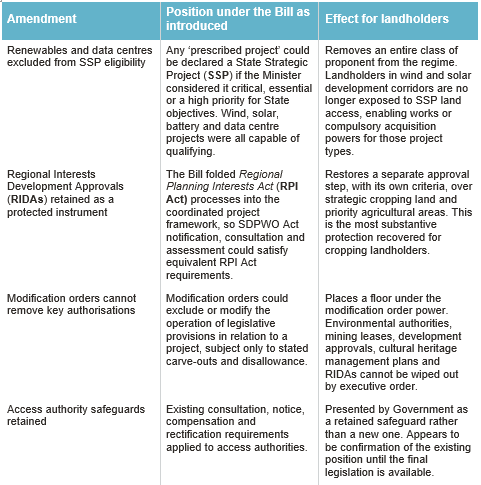
Do the amendments provide heightened protection?
Yes, but the improvement is narrower than the surrounding commentary suggests. The amendments operate on two axes only: who can be caught by the regime, and what cannot be extinguished once a project is caught. They do very little to alter the position of a landholder whose property sits within a project that is declared.
1. The renewables and data centre carve-out
This is the change with the widest practical reach, and for many landholders it will be the one that matters. Wind, solar and battery projects, together with data centres, are removed from eligibility for SSP status. A landholder negotiating with a renewables proponent on the Darling Downs or in the North Burnett is no longer negotiating in the shadow of a possible SSP declaration and the acquisition and access powers that follow it.
The limitation to note is that this is a scope restriction rather than a protection. It says nothing about the rights of a landholder affected by a project that remains eligible. It also raises an immediate structural question: whether the exclusion sits on the face of the SDWPO Act or is left to regulation. If the latter, it can be undone by the Governor in Council without returning to Parliament, and its value as a durable safeguard is materially lower.
2. Retention of the RIDA
This is the most substantive recovery of a protection that the Bill as introduced had removed. The Bill integrated RPI Act processes into the coordinated project assessment framework, allowing notification, consultation and assessment carried out under the SDPWO Act to satisfy the equivalent RPI Act requirements. The practical effect would have been to collapse a separate approval, with its own subject matter and its own criteria directed at agricultural land, into a general major projects process.
Retaining the RIDA as a protected instrument preserves a distinct decision point over strategic cropping land and priority agricultural areas. It also interacts with the third amendment: because a modification order cannot remove a RIDA where one is required; the protection has a floor beneath it rather than sitting at the discretion of the Minister.
The qualifier to test is ‘where required’. The Government's language preserves the RIDA only where the RPI Act would otherwise demand one. That leaves the scope of the RPI Act itself doing the work, and it does not extend protection to agricultural land that falls outside a designated area of regional interest.
3. The floor under modification orders
Modification orders were the provision that attracted the sharpest criticism, including from the Queensland Law Society, because they permit the executive to alter how an Act of Parliament applies to an individual project. The amendment provides that a modification order cannot remove an environmental authority, mining lease, development approval, cultural heritage management plan, or a RIDA where required.
This is a real constraint, and it answers the most extreme version of the concern. It does not, however, answer the concern as it was actually put. A modification order that cannot remove an environmental authority may still be capable of altering the process by which that authority is obtained, the conditions attaching to it, the notification and submission rights of neighbours, or the review rights available once it is granted. The distinction between removing an authorisation and reshaping the pathway to it is where the practical work will be done, and it cannot be resolved without the amendment text.
4. Access authority safeguards
The Government describes consultation, notice, compensation and rectification requirements for access authorities as retained rather than introduced. On the material presently available this appears to restate the existing position rather than add to it. It should not be counted as a gain until the amendment text confirms otherwise.
What did not change
The architecture that generated the objections survives substantially intact. For a landholder within a project that is declared, the position is close to what it was under the Bill as introduced.
- The SSP declaration test remains broad. A project may be declared where the Minister considers it critical or essential, or a high priority, for achieving State objectives. Nothing confines the regime to critical minerals. Ecotourism, tourism infrastructure and a wide range of private commercial development remain eligible.
- Modification orders still override Acts without returning to Parliament. They are made by regulation on the Minister's recommendation, subject only to disallowance. The carve-outs constrain their content; they do not restore parliamentary scrutiny of their making.
- Compulsory acquisition for private benefit remains. The power to take land for a private infrastructure facility is replaced by a power to take land for an SSP. This remains a departure from the traditional public purpose threshold, and it applies to privately owned commercial projects.
- Appeal and merits review rights remain narrowed. Nothing in the four amendments restores the ability of affected landholders, neighbours or community groups to challenge approvals and decisions on their merits.
- The compensation basis is unchanged. A concern in the agricultural industry is that market value compensation does not capture the long-term income generating capacity of agricultural land, particularly where mining activity leaves land unsuitable for primary production. That submission was not taken up.
- There is no independent agricultural impact assessment. Tied in with the above point, there is no statutory requirement for an independent assessment of agricultural impacts.
The negotiating leverage problem
One of the main issues pressed most consistently by industry groups was not that acquisition would necessarily be used, but that its availability changes the commercial dynamic. A landholder who would otherwise be negotiating an access or compensation agreement on ordinary commercial terms now negotiates knowing that the counterparty has a statutory route available if agreement is not reached. Their position was that these powers should be a genuine last resort rather than a lever.
None of the four amendments addresses this. The carve-out removes certain proponents from the class that holds the lever; it does not blunt the lever. For a landholder facing a critical minerals proponent, or a tourism or industrial proponent that remains eligible, the bargaining position is where it was when the Bill was introduced.
Practical implications
- For landholders in renewables corridors, the exposure created by the Bill has been removed, subject to confirming whether the exclusion is statutory or regulatory.
- For cropping landholders on strategic cropping land or in priority agricultural areas, the RIDA is preserved as a separate approval and cannot be modified away. This is a meaningful and usable protection.
- For grazing and mixed enterprise landholders outside a designated area of regional interest, and for any landholder facing a critical minerals, resources, industrial or tourism proponent, the amendments change very little.
- Early engagement matters more than it did. The six-month consultation period attaching to SSP applications is the principal procedural protection, and it runs from a point at which the designation is already in prospect. Advice sought after a declaration is made will have fewer levers available than advice sought before.
All the above will need careful review when the legislation is finalised and published. For those negotiating with mining and gas companies on land without protection of the RPI Act in particular, concerns about how this legislation could be used as a lever in the negotiation process remains a significant concern.
