Disclosing the reserve and other key amendments - the Consumer Legislation Amendment Bill 2026 (Vic)
26 October 2026



The Consumer Legislation Amendment Bill 2026 (Vic) (Amending Act) received royal assent on 8 September 2026. The amendments proposed by this Bill introduce significant and critical changes to the process of selling real estate in Victoria, residential leasing, and for tobacco licenced premises, changes in retail and commercial leasing.
This article summarises the key proposed changes and what it means for property owners, prospective purchasers, landlords and tenants in practice.
1. Repeal of sections governing early deposit release under a contract of sale
Prior to the Amending Act, s 27 of the Sale of Land Act 1962 (Vic) provided vendors under a contract of sale of land a statutory mechanism to request and obtain early release of the deposit held under a contract. Upon release, it is usual practice that real estate agents retain a part of the released deposit on account for their costs.
This longstanding provision has been the subject to much industry debate in recent years and has now been repealed by the Amending Act with new ss 26A and 26B being inserted into the Sale of Land Act 1962 (Vic) in its place.
Section 26A provides that a deposit held by a legal practitioner, conveyancer or estate agent as stakeholder cannot be released to the vendor before settlement unless the contract of sale itself contains an express condition allowing early release.
Section 26B prohibits an agent from deducting its costs, commissions or other entitlements from the deposit should the deposit be released prior to settlement.
This amendment will take effect on proclamation by the Government, and if no proclamation is made, it will take effect on 1 July 2027.
What it means in practice
- For Vendors – Vendors are no longer able to rely on a statutory mechanism and it is important to consider whether to include a special condition in a contract of sale permitting the early release of deposit.
- For Purchasers – Purchasers should obtain legal advice and review marketing or auction contracts and look out for special conditions permitting the early release of deposit.
2. Early provision of s 32 vendor statements
The Amending Act amends the Sale of Land Act 1962 (Vic) to require Vendors to make a vendor statement prepared in accordance with s 32 of the Sale of Land Act 1962 (Vic) at least 14 days before the ‘sale availability time.’
This new concept of ‘sale availability time is defined as follows:
- For a non-fixed date sale or auction – within 14 days of the date the land was first publicly advertised for sale, except if the land was sold within that timeframe, then it has to be provided before the purchaser signs the contract.
- For a fixed date of sale or auction – within 14 days of the first auction or fixed date of sale except if the land was sold prior to that date, then it has to be provided before the purchaser signs the contract.
- If the land is not advertised for sale, before the purchaser signs the contract.
Vendors should consider the impact of this legislation and ensure that they instruct their representatives to prepare vendor statements within the above timeframes to ensure compliance.
This amendment will take effect on proclamation by the Government, and if no proclamation is made, it will take effect on 1 July 2027.
3. Mandatory reserve price disclosure for auctions and fixed-date sales
The Amending Act amends the Estate Agents Act 1980 (Vic) and requires that on and from 1 October 2026, reserve prices in respect of a fixed date sale campaign or auction campaign be published in the advertisement for that sale at least seven days prior to the end of the fixed date of the sale campaign, or auction.
The Amending Act does not specify if subsequent changes to a reserve price can be made once the reserve price is published, but there are provisions prohibiting a fixed date sale or auction to be conducted at any time prior to seven days after the reserve price is published.
This is a significant change to how reserve prices are treated and proponents argue will provide greater clarity to the auction process.
This amendment took effect on 1 October 2026.
4. Mandatory reporting of sale price
The Amending Act amends the Estate Agents Act 1980 (Vic) and requires that agents must disclose the sale prices within seven days once a sale becomes unconditional and this must stay publicly available, for at least 18 months. This amendment took effect on 1 October 2026.
In addition to the above, a requirement to disclose sale prices to Consumer Affairs Victoria within seven days once a sale becomes unconditional will take effect on 1 December 2027.
5. Right to terminate leases of premises subject to court orders related to illicit tobacco
The Amending Act also introduces new rights available to a landlord of premises which are found to carry out a business of selling unlicensed or illicit tobacco products.
Pursuant to the Tobacco Act 1987 (Vic) the Magistrates' Court, on application by the Regulator or the Chief Commissioner of Police may issue long term closure orders of premises for a specified period where the Court is satisfied that illicit tobacco is being (or is likely to be) sold or supplied there, is held there by a tobacco supplier, or that an unlicensed tobacco supply business is being carried on there.
New ss 36ZE and 36ZF of the Tobacco Act 1987 introduced by the Amending Act permits a landlord of such premises subject to long term closure orders to terminate a lease on at least 28 days written notice, without requiring payment of compensation to the tenant. Such termination will not be a retail tenancy dispute under Part 10 of the Retail Leases Act 2003 (Vic).
When the lease ends, the long-term closure order will then cease to have effect and the former landlord must notify the Regulator within seven days of the termination of the lease.
These new rights are long overdue and provide a landlord with certainty as to their ability to terminate leases if long term closure orders are issued. However, these rights are limited to situations where a premises are subject to long term closure orders only. Landlords have to review their leases in detail to establish whether they have contractual rights to terminate leases of premises which are subject to investigation, search and seizure or short-term closure orders.
These amendments took effect on the date of Royal Assent, being 8 September 2026.
6. Cap on early-termination compensation recoverable on early termination of a residential lease
The Amending Act introduces a new s 211(3A) of the Residential Tenancies Act 1997 (Vic) which applies to fixed-term residential rental agreements of five years or less that are terminated early.
The Amending Act caps compensation that may be ordered by VCAT for loss of rent is by reference to how much of the term remained at termination:
- more than 75% of the term remaining — up to 4 weeks' rent
- between 50% and 75% remaining — up to 3 weeks' rent
- between 25% and 50% remaining — up to 2 weeks' rent
- 25% or less remaining — up to 1 week's rent.
The Amending Act also includes a suite of other residential tenancy reforms that residential landlords should be aware of including new anti-discrimination protections for renters affected by family or personal violence, a new offence of disabling keys or security devices, direct bond lodgement with the Residential Tenancies Bond Authority, and (for land-lease and manufactured home communities) a substantial rewrite of the Part 4A parks regime.
The cap sharply limits a residential landlord's recovery where a tenant breaks a fixed-term lease early.
This amendment will take effect on proclamation by the government, and if no proclamation is made, it will take effect on 1 July 2027.
6. Timing and conclusion
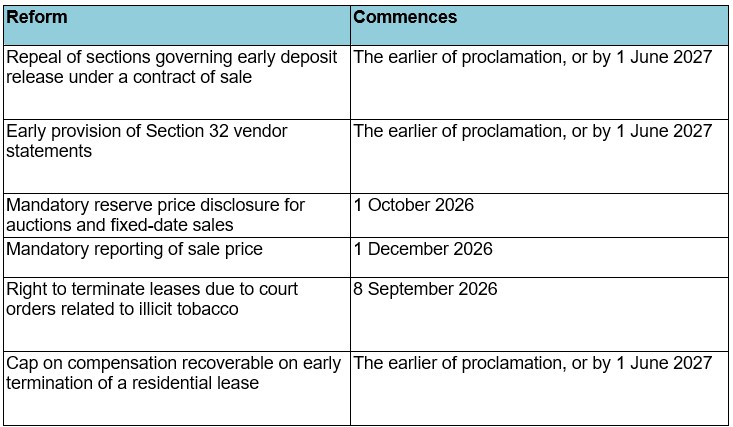
The changes are being switched on progressively over 2026 and 2027 and is summarised in the table below:
If you have any questions about how any of these amendments affect a particular transaction, lease, portfolio or campaign, or would like our help updating your precedents or internal processes, please contact the author.
