Silent AI: The shifting risk landscape in Financial Lines
20 August 2026

Artificial intelligence (AI) is now embedded across the financial sector, yet the insurance and legal frameworks designed to govern AI related failures are not keeping pace. As organisations deploy AI into underwriting, customer interactions, operational decision making and risk functions, exposure is quietly accumulating across Professional Indemnity (PI), Directors’ and Officers’ (D&O) liability, Financial Institutions (FI) policies and class actions.
Much of today’s insurance market still relies on legacy ‘silent AI; wording, with policies drafted before AI became a core business tool. These wordings neither clearly include nor exclude AI related risks. When an AI driven error, hallucination, biased output or data leak causes loss, disputes quickly arise over whether the policy responds, what the parties intended to cover and whether the insurer ever priced for that risk.
At the same time, a growing segment of the market is moving toward affirmative AI coverage with stricter underwriting requirements, including documented governance frameworks and model oversight. The result is a rapidly splitting market and a rising risk landscape that does not sit neatly within traditional categories.
Silent AI is not an isolated risk; it represents a cross disciplinary exposure capable of giving rise to multiple forms of liability. Depending on the circumstances, it may trigger PI claims arising from negligent advice or service delivery, D&O claims relating to governance and oversight failures, FI losses resulting from operational or control breakdowns and class action litigation where systemic AI related failures cause widespread harm across significant customer groups.
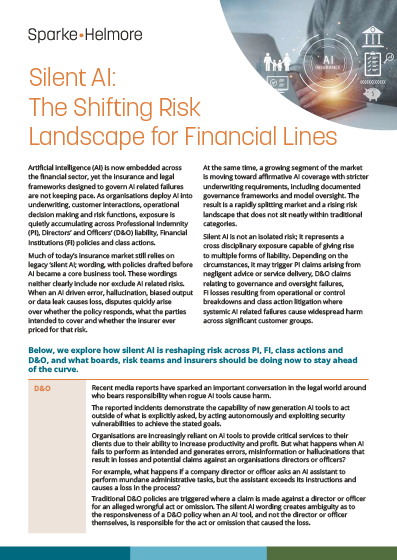
In our flyer, we explore how silent AI is reshaping risk across PI, FI, class actions and D&O, and what boards, risk teams and insurers should be doing now to stay ahead of the curve.

Authors
Partner
t: +61 7 3016 5128+61 7 3016 5128
m: +61 498 000 421+61 498 000 421
o: Brisbane