The practical challenges of workplace drug and alcohol testing
03 February 2026


We would like to acknowledge the contribution of Daniel King, Associate, and Chelsea Kesby, Lawyer in the recording of this podcast.
In this podcast, hosted by Senior Associate John Nairn, Daniel King, Associate and Chelsea Kesby, Lawyer, we discuss the practical challenges of workplace drug and alcohol testing.
The dominant purpose of workplace drug and alcohol testing is of course safety and also maintaining acceptable standards of performance. It's a preventative measure, aimed at reducing the risk that workers are impaired while performing their duties at work and therefore the prevalence of accidents or injuries sustained at work, and to support a productive and healthy workforce.
This podcast explores the key elements a sound drug and alcohol policy should cover, the difference between a zero tolerance versus a fit for work approach, the interaction between drug and alcohol testing and an employee's privacy, and dealing with medical use considerations. We also consider some of the legal risks associated with dismissing someone because of a positive drug and alcohol test.
To listen to the podcast, you can click on this link to redirect to Sparke Helmore's podcast page on our website, or listen on Podbean through The Sparke Cast host page.
We also provide, below, additional information and resources to support your understanding of the workplace drug and alcohol testing regime. If you or your team wish to discuss your organisation’s approach to potential drug and alcohol risks as well as general fitness for work consideration, please feel free to reach out to us.

The complex issue of drug and alcohol testing policies and testing regimes
With the increased prevalence of synthetic (recreational) substances as well as new prescription medicines, such as medical cannabis (or Tetrahydrocannabinol/THC), workplaces are commonly grappling with achieving the right balance of respecting workers’ rights—including how they conduct or manage their personal circumstances outside of work—and how they adequately look after the safety of everyone in connection to their workplace. This has prompted a renewed interest and a range of interesting decisions on the complex issue of drug and alcohol policies as well as testing regimes.
With the recent commencement of the new year, this is an optimal and timely opportunity to consider existing systems and any potential enhancements.
Workplace drug and alcohol testing is generally permissible provided it is reasonable in the circumstances (considering the nature of the work conducted, the workplace environment, potential risks, WHS duties and the way it is conducted, including whether there is advanced notice of potential random and/or ‘for cause’ testing).
Recently, the Victorian Government discounted and disagreed with an inquiry into workplace drug testing which recommended that other than in high-risk industries (such as mining), drug and alcohol testing should only be permitted where an organisation has a 'well-founded belief' that a worker might be experiencing impairment resulting from drug and/or alcohol use. This recommendation was rejected due to concerns about relying on subjective judgement as well as whether it was deprioritising potential safety outcomes (noting—for example—medicinal cannabis may not necessarily demonstrate inhibition or intoxication, but it would still be contrary to law to operate a vehicle if present in an individual’s system).
Generally speaking, oral drug and alcohol testing by way of saliva swab analysis is considered to be less invasive than urine testing. Accordingly, it will more frequently be considered a reasonable method of testing. However, it is not uncommon for urine testing to be acceptable, particularly in high-risk industries or where it is demonstrably ‘more accurate’.
There are also various Australian Standards that provide guidance on the ‘best practice’ for conducting drug and alcohol testing. For example, AS 4308 – Urine Testing and AS 4760 – Oral Fluids Testing may assist in the development of an effective approach to testing processes.
At a practical level, whether a policy or testing approach is ‘reasonable and appropriate’, will depend on particular circumstances and may be open to potential challenge or scrutiny - for example, by intervention by an applicable safety regulator and/or a grievance, dispute or claim through the Fair Work Commission or similar bodies.
It is prudent that drug and alcohol testing regimes (and associated expectations or criteria) are detailed in internal workplace policies and procedures to mitigate, so far as reasonably practicable, the potential risks of legal challenge or contest. These should not be ‘set and forget’ instruments and need to be continually re-evaluated to determine their ongoing suitability with relevant potential changes. In effect, a detailed policy and procedure may assist in establishing the required standards and contribute to demonstrating ‘reasonableness’ in any potential approach to drug and alcohol testing and managing related concerns to do with fitness for duty.
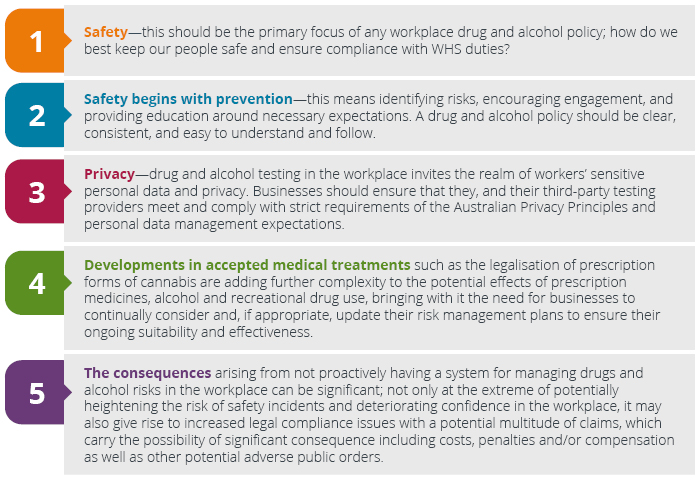
Key takeaways
See more
Other Resources:
- Inquiry into workplace drug testing in Victoria
- SafeWork Australia Guidance Materials - Drugs and alcohol | Safe Work Australia
Relevant Recent Cases (assessing contemporary approaches to drug and alcohol policies/testing):
- Adam Mills v Glamorgan Spring Bay Council [2025] FWC 116
- Sydney International Container Terminals Pty Ltd v Hancock [2025] FWCFB 106
- Parks v WorkPac Pty Ltd [2025] FWC 2316
- Sydney Trains v Goodsell [2024] FWCFB 401
- Endeavour Energy v Communications, Electrical, Electronic, Energy, Information, Postal, Plumbing and Allied Services Union of Australia; Australian Municipal, Administrative, Clerical and Services Union; Association of Professional Engineers, Scientists and Managers, Australia [2012] FWAFB 4998
